Regional quantum hub NSF HQAN is renewed to pursue industry-ready computing and workforce development

Logo of HQAN and NSF

WQI researchers are proud to be part of the groundbreaking research that will come with the next chapter of the U.S. National Science Foundation (NSF) Quantum Leap Challenge Institute for Hybrid Quantum Architectures and Networks.

NSF announced today that it has renewed the University of Illinois Urbana-Champaign-led NSF Quantum Leap Challenge Institute for Hybrid Quantum Architectures and Networks (NSF HQAN) for a second phase with $37.5 million in funding over five years.

The center brings together 45 senior researchers from six institutions to develop modular quantum computing architectures. Its participants are also working to build a quantum workforce through educational programs that have brought quantum science to over 12,000 participants.

The regional cohort is formed by Illinois, The University of Chicago, the University of Wisconsin–Madison and Northwestern University with Stanford University and the MIT Lincoln Laboratory providing critical capabilities. The second phase center will have 16 industry partners that include Google, IBM, IonQ and Quantinuum.

Read the Illinois announcement here.
 

HQAN-affiliated students get a taste of the quantum computing industry

HQAN-affiliated students get a taste of the quantum computing industry

This story was originally published by HQAN
Two students associated with HQAN got the opportunity to do internships in the quantum computing industry this past summer. Scott Turro and Kaiwen (Kevin) Gui both emerged from their experiences with a better understanding of real-world quantum computing, and better prepared for their future careers. Turro is in his senior year at UIUC, majoring in Statistics with minors in Computer Science and Physics. Since his freshman year, he’s been working on a quantum tomography project with Paul Kwiat, who is an HQAN co-PI and the Bardeen Professor of Physics. That work has involved interacting with Qubitekk, Inc.—a startup devoted to quantum components and systems—and the relationship eventually led to Turro’s internship. At Qubitekk he worked on three different projects. “Throughout all the projects,” he says, “my main goal was to write Python code that would control the devices, and document those classes so they could be used by the employees.” Daniel Mulkey, who mentored Turro at Qubitekk, praises the contributions he made over the summer. “He was phenomenal,” he says. “He regularly brought and implemented valuable ideas that we wouldn’t have picked up anywhere else.” Turro thinks that the number one thing he gained from the internship was the experience of working with real data, which wasn’t “the perfect data that I would usually simulate. So working with that real data and having those experimental problems, like the voltage varying… really gave me a grasp of what the problems are, and what we have to get through in order to put these systems into real life.” Kevin Gui is a Ph.D. student at the University of Chicago, where he’s studying quantum computing under the guidance of Martin Suchara, an HQAN investigator. Gui’s thesis research is building connections between quantum hardware and quantum algorithms. While very sophisticated algorithms are being developed for quantum computers, he explains, “hardware is not available yet for many of these fancy algorithms.” In his graduate work, he’s looking for ways “either to improve hardware, or to simplify algorithms to make them more suitable for the [available] hardware.” In his internship, which was at ColdQuanta, Inc., Gui got to focus on the hardware side, working to build better multiqubit gates. Quantum gates aren’t perfect; they can be influenced by factors such as physical noise, and fail to give the desired output. Gui explored the physics of quantum gates to seek better fidelity and less susceptibility to noise. He says the internship helped him extend his research focus beyond the level of “perfect” circuits to the real-world hardware that exists today. “I have a better sense of how the actual hardware actually functions… It made that whole picture much clearer.” At ColdQuanta, Gui was mentored by Mark Saffman (a UW–Madison physics professor and Chief Scientist for Quantum Information for ColdQuanta) and Martin Lichtman, a quantum physicist. Saffman says that Gui’s work contributed to a core initiative of the company: “Kevin’s work supported ColdQuanta’s development of a high-performance cold atom quantum computer,” he says. Both Turro and Gui think that their summer experiences will be beneficial to their future careers. Turro hopes to work in the quantum industry after completing his bachelor’s degree, and later return to school for graduate work. Gui remains undecided on his next career step, but is interested in pursuing work that focuses more on applications than theory.
Read the full article at: https://hqan.illinois.edu/news/hqan-affiliated-students-get-a-taste-of-the-quantum-computing-industry

Chicago State University students gain quantum experience through HQAN summer internships

This story was adapted from one originally published by HQAN Over the past summer, the NSF Quantum Leap Challenge Institute for Hybrid Quantum Architectures and Networks (HQAN) offered a 12-week “Research Experiences for CSU Students” …

Read the full article at: https://www.physics.wisc.edu/2021/09/27/chicago-state-university-students-gain-quantum-experience-through-hqan-summer-internships/

HQAN outreach program brings quantum science to rural Wisconsin

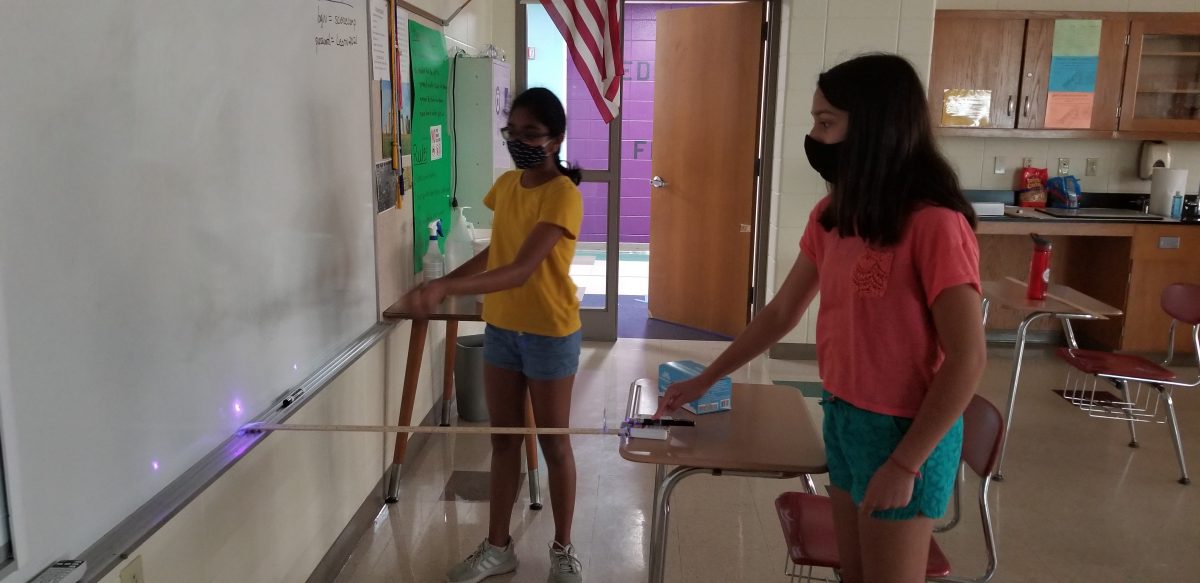
two young students using lasers and a meter stick

HQAN outreach program brings quantum science to rural Wisconsin

two young students using lasers and a meter stick
This month, the Wonders of Quantum Physics participated in the UW Biocore’s weeklong science camp in Mazomanie, WI. Read all about it in this article published in the Milwaukee Journal Sentinel.