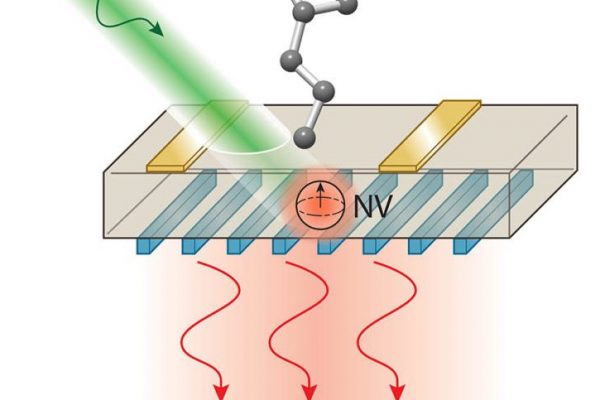
Quantum sensing makes use of the unique and counter-intuitive properties of matter and light when it is governed by quantum physics, such as quantization of energy levels, particle-wave duality, coherent superposition, and entanglement, to make precision sensors and measurements. Applications of quantum sensors range from medicine to navigation, security, materials science, and even astrophysics. One of the primary challenges in quantum sensing is to protect the quantum system that is being used as a measurement device from the deleterious effects of interacting with its surrounding environment, while remaining sensitive to the target signal.
Technologies and components for quantum sensors
Quantum sensing uses the interactions between quantum systems and their environment to precisely and sensitively measure physical quantities such as time, inertial motion, magnetic fields, and temperature.

Control and detection with quantum materials
Quantum materials host a remarkable range of emergent phenomena. Harnessing tailored light fields allows us not only to probe them but also to control them.