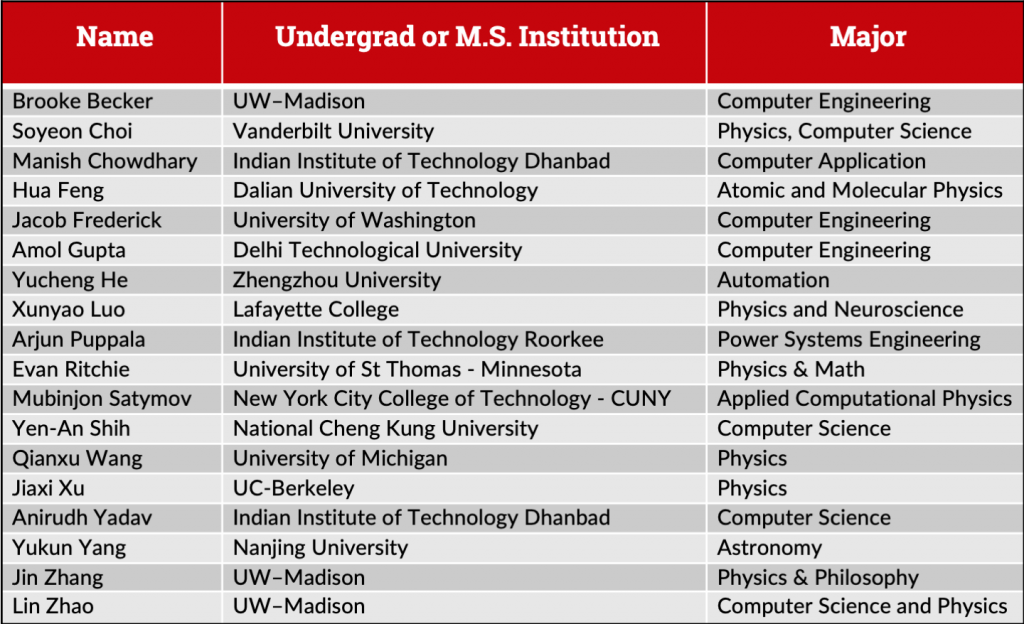
The UW–Madison Physics Department and the Wisconsin Quantum Institute are pleased to welcome 18 students to the M.S. in Physics – Quantum Computing program. These students make up the third cohort to begin the program and are the largest entering class to date. “We are really pleased and proud that the MSPQC program continues to grow and prosper in its third year,” says Bob Joynt, MSPQC Program Director, professor of physics, and WQI member. “We look forward to providing a great experience for the class of 2021. A particular focus this year will be the formation of collaborative teams that will push forward research in quantum computing.”Of note, three women are in the entering class, marking the first time that women have enrolled in MSPQC. Other facts and figures about this year’s cohort include:
11 students are coming directly from completing their Bachelors
Three students have Master’s degrees
Six students have at least four years of professional experience, and four of those students have over 10 years professional experience
15 are international students, and seven of those students have attended U.S. institutions for previous studies
The students’ academic backgrounds include physics, astronomy, engineering, and business administration.
The department is following University guidelines and is planning for students to join us in Madison this fall, with in-person instruction. Over the summer, students can attend optional virtual orientation sessions to prepare for the program. “The pandemic imposed restrictions on our admissions and recruitment activities which forced us to work virtually, but I believe these barriers made our programming more accessible and led to the most diverse and determined incoming cohort of MSPQC students to date,” says Jackson Kennedy, MSPQC coordinator. “Although I have been able to meet our incredibly talented students virtually, I cannot wait to greet them in-person this Fall as we celebrate a long-awaited return to campus.”In addition to Joynt, the department thanks the other faculty who serve on the MSPQC admissions committee — Alex Levchenko, Robert McDermott, Maxim Vavilov and Deniz Yavuz — for application review. We also thank Michelle Holland and Jackson Kennedy for organizing recruiting efforts. The MSPQC program welcomed its first students in Fall 2019 – the first-ever class of students in the U.S. to enroll in a quantum computing M.S. degree program. The accelerated program was born out of a recognized need to rapidly train students for the quantum computing workforce and is designed to be completed in 12 months. It provides students with a thorough grounding in the new discipline of quantum information and quantum computing. The 18 students of the incoming 2021 class
Flexible, easy-to-scale nanoribbons move graphene toward use in tech applications
Posted on
Flexible, easy-to-scale nanoribbons move graphene toward use in tech applications
From radio to television to the internet, telecommunications transmissions are simply information carried on light waves and converted to electrical signals.
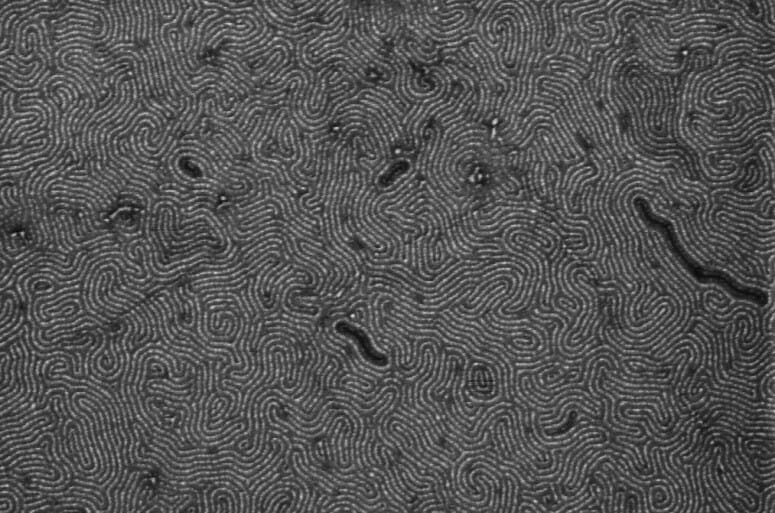
University of Wisconsin–Madison researchers produced the smallest ribbons of graphene yet created, at about 12 nanometers in width, in efforts to use the all-carbon, ultra-thin and adaptable material to improve internet and other kinds of telecommunications performance. The structures, which act like tiny antennas that interact with light, are too small to see with the naked eye. IMAGE COURTESY OF STUDY AUTHORS.
Silicon-based fiber optics are currently the best structures for high-speed, long distance transmissions, but graphene — an all-carbon, ultra-thin and adaptable material — could improve performance even more.
In a study published April 16 in ACS Photonics, University of Wisconsin–Madison researchers fabricated graphene into the smallest ribbon structures to date using a method that makes scaling-up simple. In tests with these tiny ribbons, the scientists discovered they were closing in on the properties they needed to move graphene toward usefulness in telecommunications equipment.
“Previous research suggested that to be viable for telecommunication technologies, graphene would need to be structured prohibitively small over large areas, (which is) a fabrication nightmare,” says Joel Siegel, a UW–Madison graduate student in physics professor Victor Brar’s group and co-lead author of the study. “In our study, we created a scalable fabrication technique to make the smallest graphene ribbon structures yet and found that with modest further reductions in ribbon width, we can start getting to telecommunications range.”
For the full story, please visit: https://news.wisc.edu/flexible-easy-to-scale-nanoribbons-move-graphene-toward-use-in-tech-applications/