Flexible, easy-to-scale nanoribbons move graphene toward use in tech applications
Posted on
Flexible, easy-to-scale nanoribbons move graphene toward use in tech applications
From radio to television to the internet, telecommunications transmissions are simply information carried on light waves and converted to electrical signals.
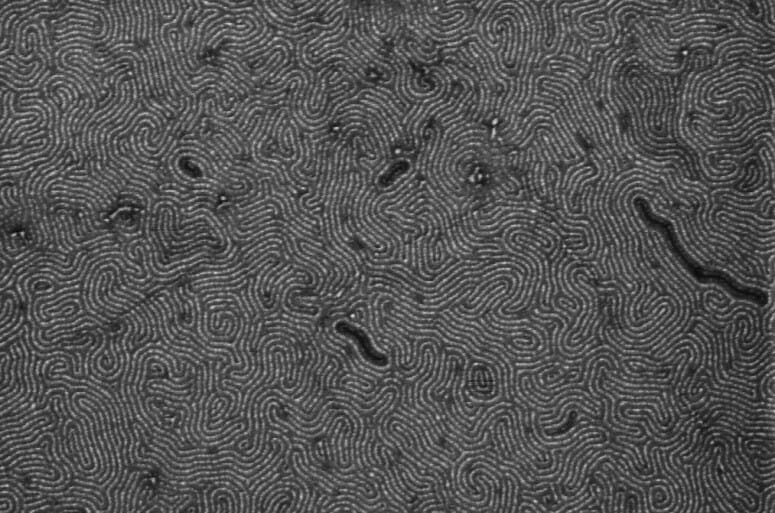
University of Wisconsin–Madison researchers produced the smallest ribbons of graphene yet created, at about 12 nanometers in width, in efforts to use the all-carbon, ultra-thin and adaptable material to improve internet and other kinds of telecommunications performance. The structures, which act like tiny antennas that interact with light, are too small to see with the naked eye. IMAGE COURTESY OF STUDY AUTHORS.
Silicon-based fiber optics are currently the best structures for high-speed, long distance transmissions, but graphene — an all-carbon, ultra-thin and adaptable material — could improve performance even more.
In a study published April 16 in ACS Photonics, University of Wisconsin–Madison researchers fabricated graphene into the smallest ribbon structures to date using a method that makes scaling-up simple. In tests with these tiny ribbons, the scientists discovered they were closing in on the properties they needed to move graphene toward usefulness in telecommunications equipment.
“Previous research suggested that to be viable for telecommunication technologies, graphene would need to be structured prohibitively small over large areas, (which is) a fabrication nightmare,” says Joel Siegel, a UW–Madison graduate student in physics professor Victor Brar’s group and co-lead author of the study. “In our study, we created a scalable fabrication technique to make the smallest graphene ribbon structures yet and found that with modest further reductions in ribbon width, we can start getting to telecommunications range.”
For the full story, please visit: https://news.wisc.edu/flexible-easy-to-scale-nanoribbons-move-graphene-toward-use-in-tech-applications/
Deniz Yavuz announced as Vilas Associate
Posted on
Deniz Yavuz announced as Vilas Associate
The Office of the Vice Chancellor for Research and Graduate Education has announced 23 faculty winners of the Vilas Associates Competition, including WQI faculty member Deniz Yavuz. The Vilas Associates Competition recognizes new and ongoing research of the highest quality and significance.
The award is funded by the William F. Vilas Estate Trust.
Recipients are chosen competitively by the divisional research committees on the basis of a detailed proposal. Winners receive up to two-ninths of research salary support (including the associated fringe costs) for both summers 2021 and 2022, as well as a $12,500 flexible research fund in each of the two fiscal years. Faculty paid on an annual basis are not eligible for the summer salary support but are eligible for the flexible fund portion of this award.
MSPQC student Jacques Van Damme publishes first-author paper with WQI faculty
Posted on
MSPQC student Jacques Van Damme publishes first-author paper with WQI faculty
Congrats to Jacques Van Damme, a member of the first class of MSPQC students who graduated this past August, on his first-author publication! The study, published in Physical Review A, is titled, “Impacts of random filling on spin squeezing via Rydberg dressing in optical clocks.” Co-authors include WQI faculty members Mark Saffman, Maxim Vavilov, and senior author Shimon Kolkowitz. | Link to the PRA publication