Smooth sailing for electrons in graphene

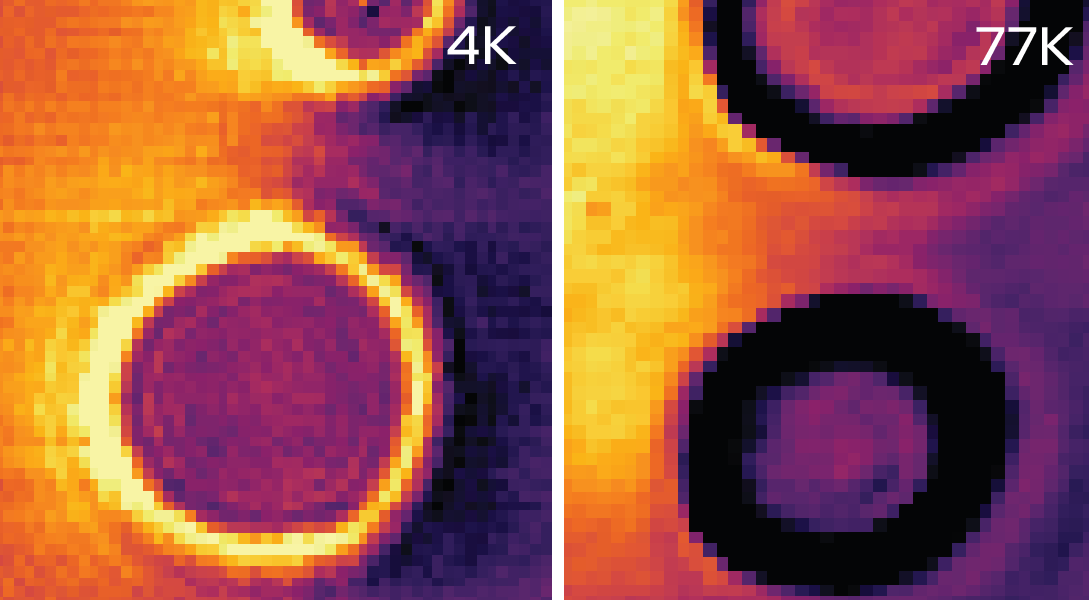
two panels in heat-map style. both panels have circles in the middle. The panel on the left has more yellow and red to the left of the circle and a bright yellow ring around the circle; the right panel has a less sharp transition of colors from left to right and no bright ring around the circles.

Smooth sailing for electrons in graphene

two panels in heat-map style. both panels have circles in the middle. The panel on the left has more yellow and red to the left of the circle and a bright yellow ring around the circle; the right panel has a less sharp transition of colors from left to right and no bright ring around the circles.
Physicists at the University of Wisconsin–Madison directly measured, for the first time at nanometer resolution, the fluid-like flow of electrons in graphene. The results, which will appear in the journal Science on Feb. 17, have applications in developing new, low-resistance materials, where electrical transport would be more efficient. Graphene, an atom-thick sheet of carbon arranged in a honeycomb pattern, is an especially pure electrical conductor, making it an ideal material to study electron flow with very low resistance. Here, researchers intentionally added impurities at known distances and found that electron flow changes from gas-like to fluid-like as temperatures rise. “All conductive materials contain impurities and imperfections that block electron flow, which causes resistance. Historically, people have taken a low-resolution approach to identifying where resistance comes from,” says Zach Krebs, a physics graduate student at UW–Madison and co-lead author of the study. “In this study, we image how charge flows around an impurity and actually see how that impurity blocks current and causes resistance, which is something that hasn’t been done before to distinguish gas-like and fluid-like electron flow.”

Read the full story

Women in STEM: In Conversation with Assistant Professor Jennifer Choy

Women in STEM: In Conversation with Assistant Professor Jennifer Choy

WQI’s Jen Choy was featured in an AZoQuantum feature for International Day of Women and Girls in Science. Read the piece here.

Announcing the Wisconsin Quantum Computing Club (WQCC)!

Announcing the Wisconsin Quantum Computing Club (WQCC)!

The Wisconsin Quantum Computing Club has just formed! Anyone interested should fill this form out. The first meeting is on Thursday, February 9th from 7:00pm to 8:00pm, in the CS Building, Room 1221. graphic announcing the formation of WQCC. for full details visit the link in the story.