UW–Madison named member of new $25 million Midwest quantum science institute
Posted on
UW–Madison named member of new $25 million Midwest quantum science institute
As joint members of a Midwest quantum science collaboration, the University of Wisconsin–Madison, the University of Illinois at Urbana–Champaign and the University of Chicago have been named partners in a National Science Foundation Quantum Leap Challenge Institute, NSF announced Tuesday.
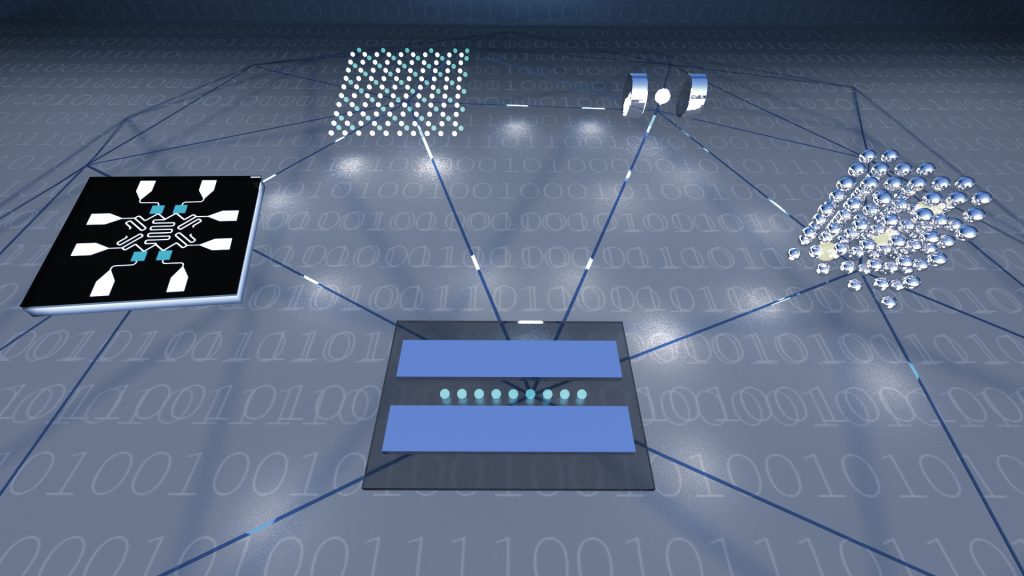
The five-year, $25 million NSF Quantum Leap Challenge Institute for Hybrid Quantum Architectures and Networks (HQAN) was one of three in this first round of NSF Quantum Leap funding and helps establish the region as a major hub of quantum science. HQAN’s principal investigator, Brian DeMarco, is a professor of physics at UIUC. UW–Madison professor of physics Mark Saffman and University of Chicago engineering professor Hannes Bernien are co-principal investigators.
“HQAN is very much a regional institute that will allow us to accelerate in directions in which we’ve already been headed and to start new collaborative projects between departments at UW–Madison as well as between us, the University of Illinois, and the University of Chicago.” says Saffman, who is also director of the Wisconsin Quantum Institute. “These flagship institutes are being established as part of the National Quantum Initiative Act that was funded by Congress, and it is a recognition of the strength of quantum information research at UW–Madison that we are among the first.”
Read the full storyIn a hybrid quantum network, hardware for storing and processing quantum information is linked together. This design could be beneficial for applications that rely on distributed quantum computing resources. | Credit: E. Edwards, IQUIST
Chicago Quantum Exchange, including WQI, welcomes seven new partners in tech, computing and finance, to advance research and training
Posted on
Chicago Quantum Exchange, including WQI, welcomes seven new partners in tech, computing and finance, to advance research and training
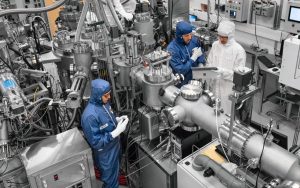
Scientists in Microsoft Quantum Lab Delft conducting research in pursuit of a topologically protected qubit. Microsoft is one of seven new computing, tech and finance companies to join the Chicago Quantum Exchange | Credit: Microsoft
The Chicago Quantum Exchange, a growing intellectual hub for the research and development of quantum technology that includes the Wisconsin Quantum Institute, has added to its community seven new corporate partners in computing, technology and finance that are working to bring about and primed to take advantage of the coming quantum revolution.
These new industry partners are Intel, JPMorgan Chase, Microsoft, Quantum Design, Qubitekk, Rigetti Computing, and Zurich Instruments.
The Chicago Quantum Exchange and its corporate partners advance the science and engineering necessary to build and scale quantum technologies and develop practical applications. The results of their work – precision data from quantum sensors, advanced quantum computers and their algorithms, and securely transmitted information – will transform today’s leading industries. The addition of these partners brings a total of 13 companies into the Chicago Quantum Exchange to work with scientists and engineers at universities and the national laboratories in the region.
Full story
New method measures temperature within 3D objects
Posted on
New method measures temperature within 3D objects
University of Wisconsin–Madison engineers have made it possible to remotely determine the temperature beneath the surface of certain materials using a new technique they call depth thermography. The method may be useful in applications where traditional temperature probes won’t work, like monitoring semiconductor performance or next-generation nuclear reactors.
Many temperature sensors measure thermal radiation, most of which is in the infrared spectrum, coming off the surface of an object. The hotter the object, the more radiation it emits, which is the basis for gadgets like thermal imaging cameras.
Depth thermography, however, goes beyond the surface and works with a certain class of materials that are partially transparent to infrared radiation.
“We can measure the spectrum of thermal radiation emitted from the object and use a sophisticated algorithm to infer the temperature not just on the surface, but also underneath the surface, tens to hundreds of microns in,” says Mikhail Kats, a UW–Madison professor of electrical and computer engineering. “We’re able to do that precisely and accurately, at least in some instances.”
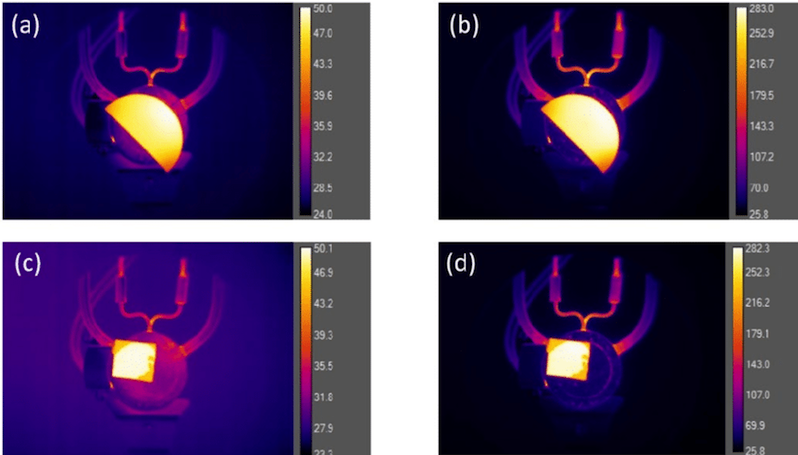
Read the full story here.An infrared image of the fused silica window used to test the depth thermography concept. For the project, the team heated the silica, a type of glass, and analyzed it using a spectrometer. They then measured temperature readings from various depths of the sample. IMAGE COURTESY OF MIKHAIL KATS