Events During the Week of March 8th through March 15th, 2026
Monday, March 9th, 2026
- Plasma Physics (Physics/ECE/NE 922) Seminar
- Versatile Nonlinear Laser-based Diagnostics for High Spatio-temporal Measurements in High to Low Pressure Plasmas
- Time: 12:00 pm - 1:00 pm
- Speaker: Prof. Marien Simeni, University of Minnesota
- Abstract: Highly sensitive, space-time resolved electric field vector measurements are essential for addressing numerous critical questions across nearly all sub-fields of plasma physics. These measurements are crucial for understanding edge-localized mode plasma instabilities in tokamaks, unraveling surface streamers and ionization wave dynamics, analyzing surface charging in low-temperature plasmas, gaining insights into magnetic reconnection events, and validating fundamental sheath theories under different collisionality regimes. In this talk, I will present a novel laser-based approach for electric field measurements that offers exceptional sensitivity across multiple orders of magnitude and is suitable for both high and low pressure plasmas. Additionally, I will demonstrate how this setup can simultaneously perform gas density measurements, providing reduced electric field estimates. We anticipate that this newly developed approach will be applicable to a wide variety of plasma physics sub-fields, making electric field measurements more accessible and straightforward.
Bio: Marien Simeni is an Assistant Professor at the Mechanical Engineering Department of the University of Minnesota (UMN), where he started in April 2022. His research group focuses on the development of ultrafast laser diagnostics to unravel kinetic mechanisms and energy transfers in non-equilibrium and laser-produced plasmas as well as in reactive flows. Marien received his B.S. in physics from Ecole Normale Superieure Cachan and Université Pierre et Marie Curie (France) in 2009, his M.S. in aerospace engineering from Ecole Centrale Paris (France) in 2011 and his Ph.D. in aerospace engineering from the same institution in 2015. He subsequently held a postdoctoral position at the Ohio State University (2015-2018), a research associate position at UMN (2018-2020) and an associate research physicist position at the Princeton Plasma Physics Laboratory (2020-2022). Marien is a recipient of the 2024 DOE Early Career Award. Tuesday, March 10th, 2026
- Physics Education Innovation Forum
- What You Need to Know about AI in the Classroom
- Time: 1:00 pm - 2:00 pm
- Place: Sterling Hall room B343 and on Zoom
- Speaker: John Martin and Janet Staker Woerner, UW-Madison Center for Teaching, Learning and Mentoring
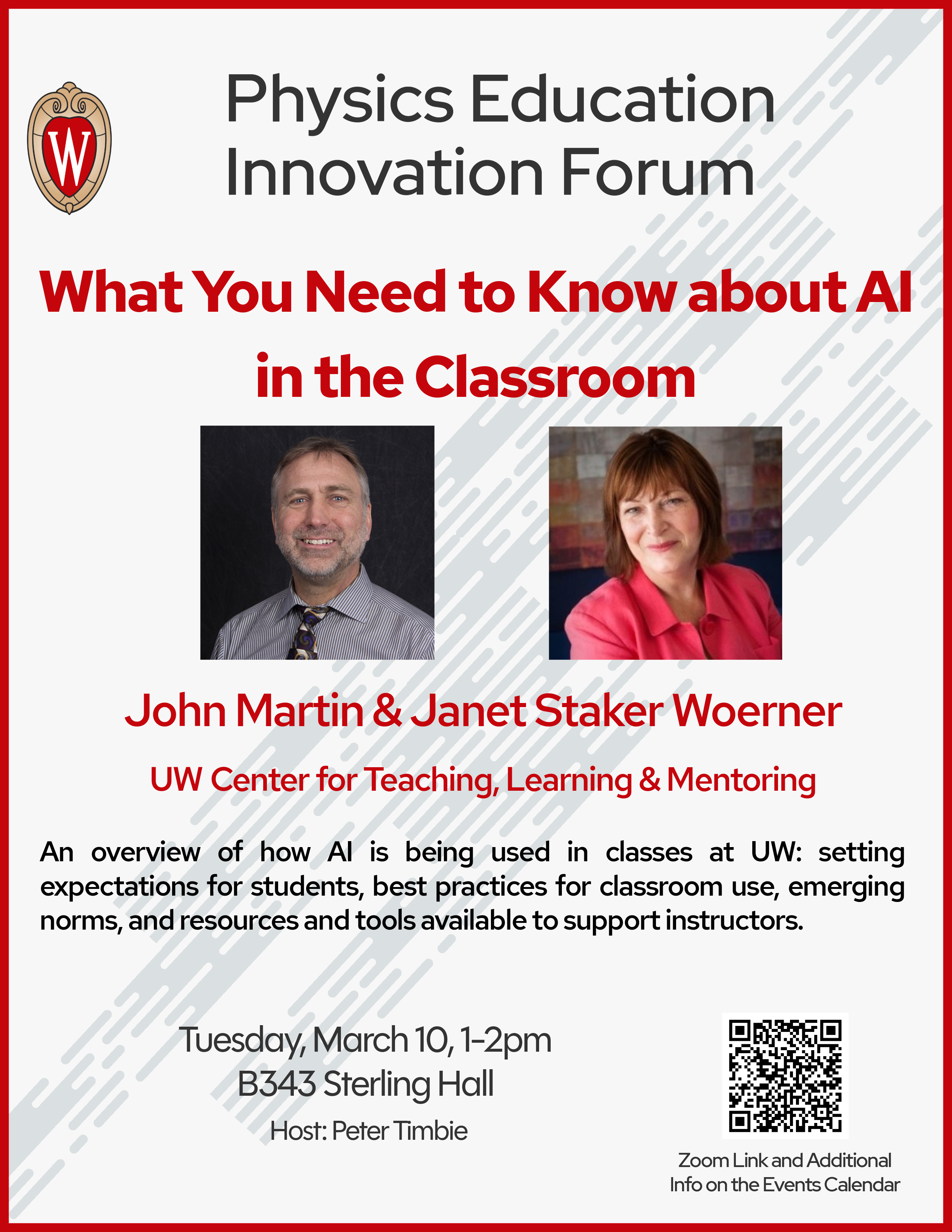
- Abstract: This month the PEI Forum is hosting two speakers from the Center for Teaching, Learning, and Mentoring to give the Department an overview of how AI is being used in classrooms at UW. They will lead a discussion of: setting expectations for students, best practices for classroom use, emerging norms, and resources and tools available to support instructors at UW Madison: Google Gemini, Microsoft Copilot, and NotebookLM. We anticipate this will be the first of many discussions on using AI for teaching.
- Host: Josh Weber
- Council Meeting
- Time: 3:00 pm - 4:00 pm
- Place: 2314 Chamberlin
- Speaker: Kevin Black
- Host: Kevin Black
Wednesday, March 11th, 2026
- Department Meeting
- Council of Full Professors
- Council of Full Professors
- Time: 12:15 pm - 1:15 pm
- Place: B343 Sterling and video link to be sent later.
- Speaker: Kevin Black, UW - Madison, Department of Physics
- Closed meeting to discuss faculty personnel matters—pursuant to Section 19.85(1)(c) of the Wisconsin Open Meetings Law
- Host: Kevin Black
Thursday, March 12th, 2026
- R. G. Herb Condensed Matter Seminar
- Only the ambidextrous can flock: chirality destroys order in polar active matter
- Time: 10:00 am - 11:00 am
- Place: 5310 Chamberlin Hall
- Speaker: John Toner, University of Oregon
- Abstract: I'll show that flocks of chiral living creatures (i.e., organisms that are right or left handed) moving on a surface, composed of critters can not form a long range ordered flocking state (i.e., a state in which the spatially averaged velocity vector
- Host: Alex Levchenko
- Astronomy Colloquium
- Probing Supermassive Black Holes in the Golden Era of Time Domain Astronomy
- Time: 3:30 pm - 4:30 pm
- Place: 4421 Sterling Hall
- Speaker: Dr. Jason Hinkle, University of Illinois Urbana-Champaign
- Abstract: Optical transient surveys have ushered in the golden era of time-domain astronomy and exposed an unexpected diversity of transient phenomena, including nuclear transients: flares powered by accretion onto supermassive black holes (SMBHs). These transients provide a means to identify and study otherwise quiescent SMBHs across a range of masses and redshifts. This complements the longstanding study of actively-accreting SMBHs, or active galactic nuclei (AGNs). In this talk, I will discuss the physics underpinning these transients, the role of the surrounding nuclear environment in setting their observable signatures, and their utility as probes of SMBHs. I will conclude with a look towards the future of nuclear transients in the era of deep surveys like LSST and Roman.
Friday, March 13th, 2026
- Graduate Program Event
- Prospective Visit Days
- Time: 8:00 am
- Place: 5280 CH
- Speaker: Sharon Kahn
- Condensed Matter Theory Group Seminar
- The whole is greater than the sum of its parts – a multimethod, multimessenger perspective on the quantum many-body problem
- Time: 11:00 am - 12:00 pm
- Place: 5310 Chamberlin Hall
- Speaker: Thomas Schaefer, University of Trieste
- Abstract: Quantum materials in which electrons strongly interact with each other exhibit fascinating examples of contemporary condensed matter physics. Thrilling instances include the celebrated cuprates, organic charge-transfer salts, heavy fermion compounds, moiré transition metal dichalcogenides, and ultracold atomic gases. Their phase diagrams are extremely rich, hosting intriguing phenomena like unconventional superconductivity, quantum criticality, and quantum magnetism. Furthermore, from a more practical point of view, they carry the potential for many functional applications like ultrafast switching and spintronics. At the same time, due to their strongly interacting constituents, they pose a huge challenge to current quantum many-body theory. In my talk I will argue that a certain perspective on strongly correlated systems, which we coined multimethod, multimessenger approach, can be a very powerful and versatile tool for the description and understanding of these systems. I will first illustrate the power of the approach with two studies of the most fundamental model for electronic correlations, the Hubbard model, on the square [1] and triangular [2] lattice. Second, I will demonstrate how these model studies paved the way for advancing our understanding of magnetism in infinite-layer nickelates [3] and moiré transition metal dichalcogenides [4], as well as the unconventional superconducting properties in organic charge-transfer salts [5]. Given their broadness in applications, these examples may serve as blueprints for future studies of strongly correlated systems. [1] T. Schäfer, et al., Phys. Rev. X 11, 011058 (2021). [2] A. Wietek, R. Rossi, F. Šimkovic IV, M. Klett, P. Hansmann, M. Ferrero, E. M. Stoudenmire, T. Schäfer, and A. Georges, Phys. Rev. X 11, 041013 (2021). [3] R. A. Ortiz, P. Puphal, M. Klett, F. Hotz, R. K. Kremer, H. Trepka, M. Hemmida, H.-A. Krug von Nidda, M. Isobe, R. Khasanov, H. Luetkens, P. Hansmann, B. Keimer, T. Schäfer, M. Hepting, Phys. Rev. Research 4, 023093 (2022). [4] P. Tscheppe, J. Zang, M. Klett, S. Karakuzu, A. Celarier, Z. Cheng, T. A. Maier, M. Ferrero, A. J. Millis, and T. Schäfer, PNAS 121, 3 (2024). [5] H. Menke, M. Klett, K. Kanoda, A. Georges, M. Ferrero, and T. Schäfer, Phys. Rev. Lett. 133, 136501 (2024).
- Host: Elio König
- Physics Department Colloquium
- Birth, Death, and Flocking: The Hydrodynamics of Dry Active matter
- Time: 3:30 pm - 6:00 pm
- Place: 2241 Chamberlin Hall
- Speaker: John Toner, U Oregon
- Abstract: In creatures ranging from birds to fish to wildebeest, we observe the collective and coherent motion of large numbers of organisms, known as ‘flocking’. In this talk, I'll use the hydrodynamic theory of flocking to explain why a crowd of people can all walk, but not point, in the same direction. Along the way I'll illustrate how one goes about formulating a hydrodynamic theory for heretofore unconsidered states and system, using powerful techniques from theoretical condensed matter physics such as hydrodynamic theories, the gradient expansion, and the renormalization group, and using concepts from fluid mechanics.
- Host: Alex Levchenko